The Narrative Came First: How a $3.99 E-book Became a “Spyware” Case Against Craig Matthew Feigin That the Record Does Not Support
The parties give materially conflicting accounts and no court or official body has resolved the central factual question. We report what each side says and what the public evidence shows, without drawing a conclusion the record does not support.
How we classify outcomes- Court
- Circuit Court, Eighth Judicial Circuit, Alachua County, Florida. A federal prosecution followed the October 27, 2008, transfer of case 01 2008 CF 003341 A; the federal court and case number have not yet been confirmed from court records.
- Case number
- 01 2008 CF 003341 A; 01 2008 CF 003956 A (Alachua County, Florida). Federal case number: not yet reviewed.
- Outcome
- In state court, a video-voyeurism count was not prosecuted and other computer counts were closed without trial; the principal computer case was transferred for federal prosecution, and Feigin says he later pleaded guilty and received a 30-month sentence.
- Jurisdiction
- Florida, U.S. Federal Courts
- Year
- 2008
- Categories
- Criminal Proceedings
Last reviewed: · Updated · Drafted with AI assistance and checked against the sources below
1Case overview
The Letter She Filed With the Court
On August 28, 2008, the then-girlfriend of Craig Matthew Feigin filed a letter with the Alachua County Clerk, addressed to the judge in his state case. It is the only supplied witness statement that bears a court filing stamp. Her name, contact information, and the investigating detective's surname have been redacted. The file stamp, case number, date, and body of the letter are shown as they appear in the filing.
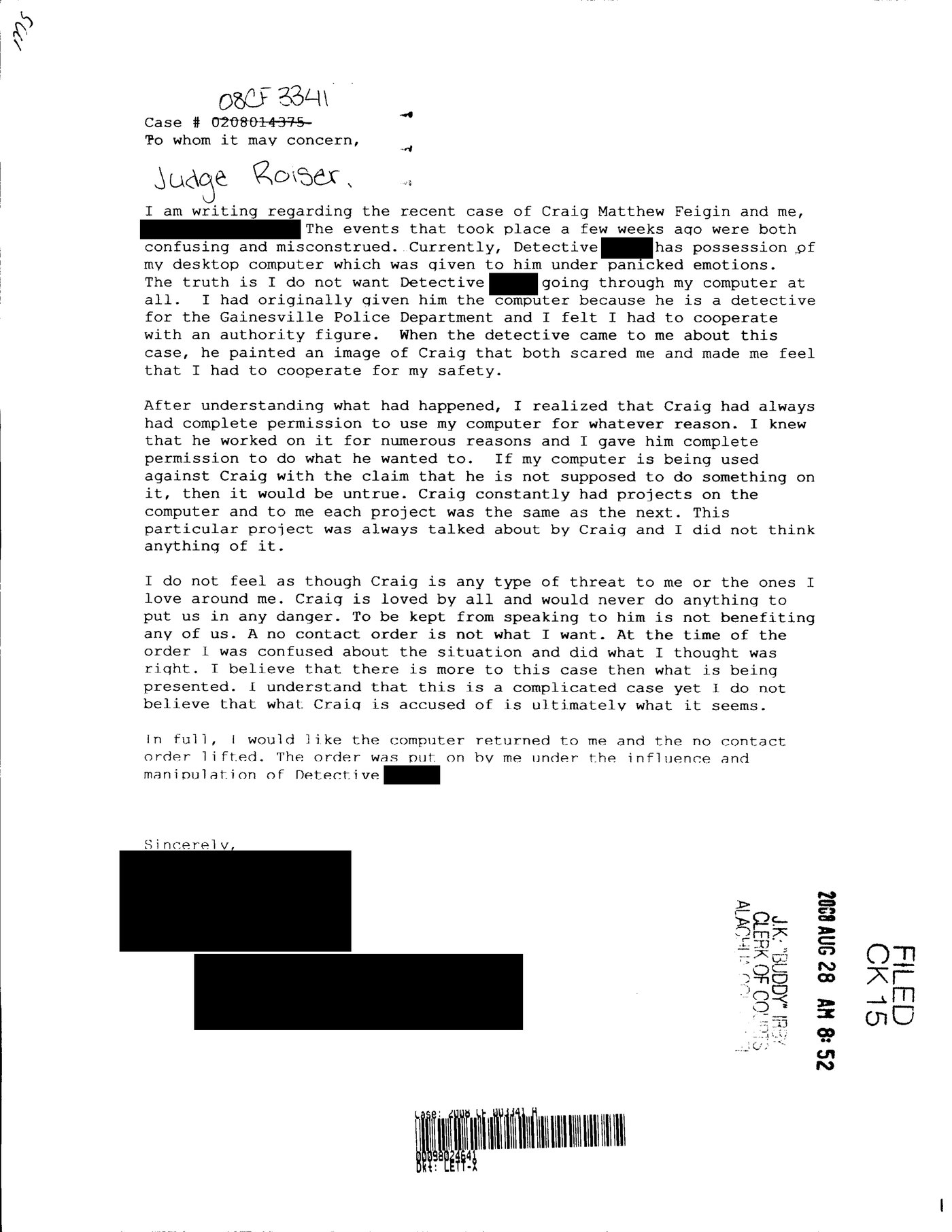
Verbatim transcription, identifiers redacted
To whom it may concern,
Judge Roiser,
I am writing regarding the recent case of Craig Matthew Feigin and me, [redacted]. The events that took place a few weeks ago were both confusing and misconstrued. Currently, Detective [the detective] has possession of my desktop computer which was given to him under panicked emotions. The truth is I do not want Detective [the detective] going through my computer at all. I had originally given him the computer because he is a detective for the Gainesville Police Department and I felt I had to cooperate with an authority figure. When the detective came to me about this case, he painted an image of Craig that both scared me and made me feel that I had to cooperate for my safety.
After understanding what had happened, I realized that Craig had always had complete permission to use my computer for whatever reason. I knew that he worked on it for numerous reasons and I gave him complete permission to do what he wanted to. If my computer is being used against Craig with the claim that he is not supposed to do something on it, then it would be untrue. Craig constantly had projects on the computer and to me each project was the same as the next. This particular project was always talked about by Craig and I did not think anything of it.
I do not feel as though Craig is any type of threat to me or the ones I love around me. Craig is loved by all and would never do anything to put us in any danger. To be kept from speaking to him is not benefiting any of us. A no contact order is not what I want. At the time of the order I was confused about the situation and did what I thought was right. I believe that there is more to this case then what is being presented. I understand that this is a complicated case yet I do not believe that what Craig is accused of is ultimately what it seems.
In full, I would like the computer returned to me and the no contact order lifted. The order was put on by me under the influence and manipulation of Detective [the detective].
Sincerely,
[redacted]
The addressee is written in the letter as “Judge Roiser.” The docket spells the name Rosier. The typo “then” for “than” appears in the original. The letter is discussed further in section 4.
Fact check
Did the then-girlfriend say Feigin lacked permission to use her computer?
False
Her filed letter says he “had always had complete permission to use my computer for whatever reason.” She added that a claim he was “not supposed to do something on it” “would be untrue.”
Source: Letter filed Aug. 28, 2008, Alachua County Clerk, Case 01-2008-CF-003341, p. 1 (documented, E-5).
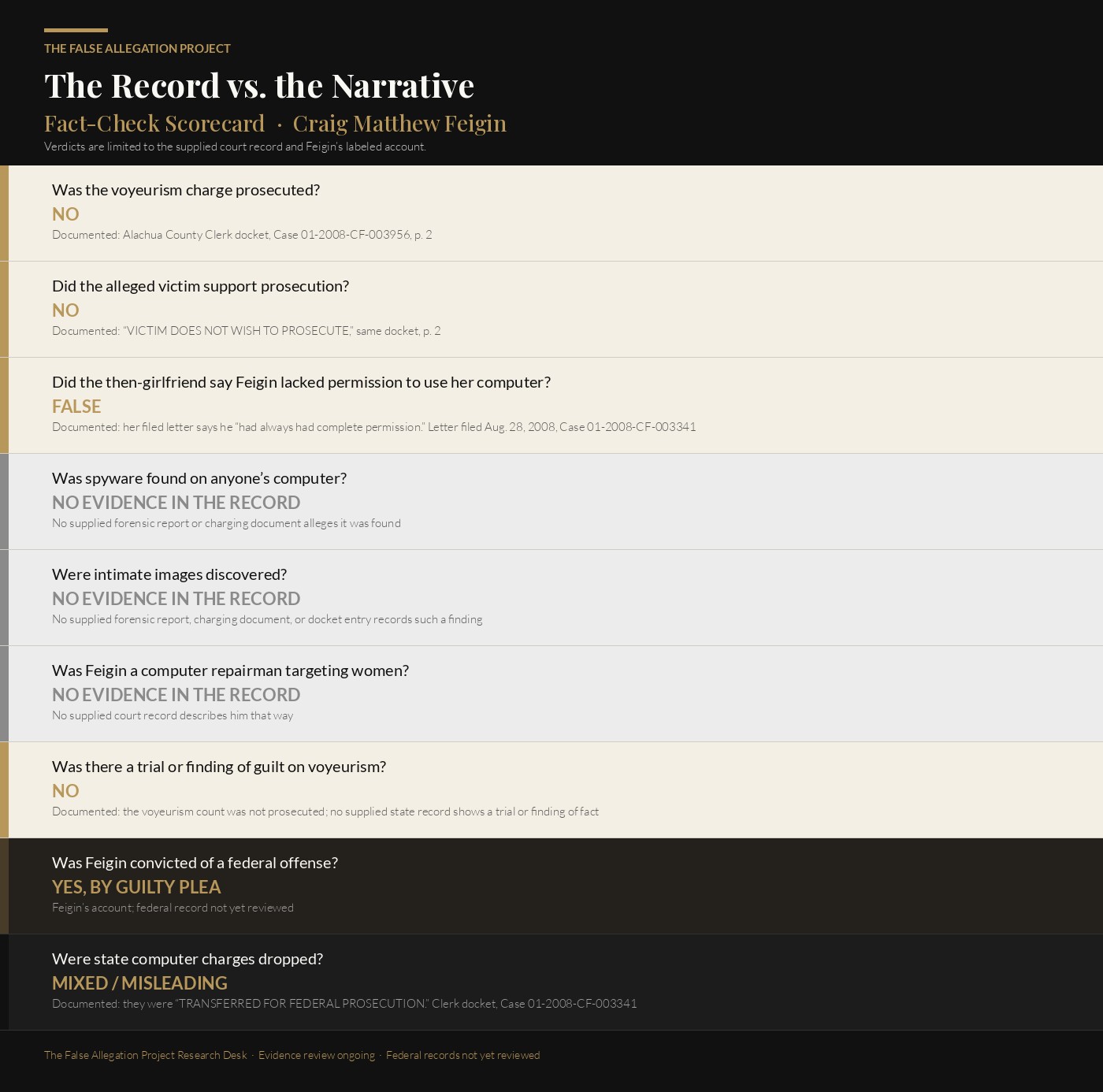
The Record vs. the Narrative
Fact-Check Scorecard
Verdicts are limited to the supplied court record and Feigin's labeled account. Federal records have not yet been reviewed.
- Was the voyeurism charge prosecuted? No Documented, E-4: “CASE DISQUALIFIED FOR PROSECUTOR STANDARDS.” Alachua County Clerk docket, Case 01-2008-CF-003956, p. 2.
- Did the alleged victim support prosecution? No Documented, E-4: “VICTIM DOES NOT WISH TO PROSECUTE.” Same docket, p. 2.
- Did the then-girlfriend say Feigin lacked permission to use her computer? False Documented, E-5: her filed letter says he “had always had complete permission.” Letter filed Aug. 28, 2008, Case 01-2008-CF-003341.
- Was spyware found on anyone's computer? No evidence in the record No supplied forensic report or charging document alleges it was found.
- Were intimate images discovered? No evidence in the record No supplied forensic report, charging document, or docket entry records such a finding.
- Was Feigin a computer repairman targeting women? No evidence in the record No supplied court record describes him that way.
- Was there a trial or finding of guilt on voyeurism? No Documented: the voyeurism count was not prosecuted; no supplied state record shows a trial or finding of fact.
- Was Feigin convicted of a federal offense? Yes, by guilty plea Feigin's account of a guilty plea to a computer-related offense; federal record not yet reviewed.
- Were state computer charges dropped? Mixed / misleading Documented, E-3: they were “TRANSFERRED FOR FEDERAL PROSECUTION.” Clerk docket, Case 01-2008-CF-003341.
At a glance: what the supplied record establishes so far
- Arrest and charges. Craig Matthew Feigin was arrested on July 31, 2008, in a Gainesville Police Department case. Florida filed felony case 01 2008 CF 003341 A the same day, charging two third-degree felonies described on the docket as computer offenses. (Alachua County Clerk docket and case summary, Case 01-2008-CF-003341; uncertified Clerk printouts, including a combined printout that also lists Case 01-2008-CF-003956)
- A second case with a voyeurism count. A second state case, 01 2008 CF 003956 A, included one count described as "SEX OFFENSE: VIDEO VOYEURISM SUBSQ OFF," plus the same two computer-offense descriptions. (Alachua County Clerk docket, Case 01-2008-CF-003956, p. 2)
- Both cases closed on October 27, 2008, in different ways.
- Case 003341: the computer counts were marked "TRANSFERRED FOR FEDERAL PROSECUTION." (Alachua County Clerk docket, Case 01-2008-CF-003341)
- Case 003956: the voyeurism count was marked "CASE DISQUALIFIED FOR PROSECUTOR STANDARDS," and the computer counts "NO INFO VICTIM DOES NOT WISH TO PROSECUTE." (Alachua County Clerk docket, Case 01-2008-CF-003956, p. 2)
- No state trial or conviction. No supplied state record shows a trial, a conviction, or any judicial finding of fact. The supplied Clerk printouts are uncertified and are not complete case files.
- The then-girlfriend's 2008 letter. In August 2008, Feigin's then-girlfriend filed a letter with the state judge. She asked for her computer back and for the no-contact order to be lifted. She wrote that Feigin "had always had complete permission to use my computer." (Letter filed Aug. 28, 2008, Alachua County Clerk, Case 01-2008-CF-003341, p. 1)
- What remains unsupplied. The federal guilty plea, the conviction, and the 30-month sentence are reported here as Feigin's account. No federal record has been supplied.
In 2008, Craig Matthew Feigin, then a college student in Gainesville, Florida, was arrested and charged in two state felony cases after what he describes as an investigation that began with a $3.99 eBay e-book titled "Webcam Spy Hacker." Feigin says the product was a written guide to building a motion-detection camera for one's own home, not spyware, and that no images of other people were ever obtained. Those claims have not yet been tested against a forensic report or a copy of the e-book itself.
The supplied Alachua County Clerk records, which are uncertified web printouts and not complete case files, show that Florida filed case 01 2008 CF 003341 A on July 31, 2008, charging two third-degree computer offenses, and that a second case, 01 2008 CF 003956 A, also included a count described as "SEX OFFENSE: VIDEO VOYEURISM SUBSQ OFF." On October 27, 2008, the voyeurism count was marked "CASE DISQUALIFIED FOR PROSECUTOR STANDARDS," the computer counts in case 003956 were marked "NO INFO VICTIM DOES NOT WISH TO PROSECUTE," and the computer counts in case 003341 were marked "TRANSFERRED FOR FEDERAL PROSECUTION." No supplied state record shows a trial, a conviction, or a judicial finding of fact.
Feigin says he later pleaded guilty in federal court to a computer-related offense and was sentenced to 30 months in federal prison. No federal court record has yet been reviewed. In a letter filed with the state court on August 28, 2008, Feigin's then-girlfriend wrote that he "had always had complete permission to use my computer." This case study is classified as Disputed because the public narrative Feigin describes and the incomplete court record now in hand give materially different pictures of the case, and because the federal outcome has not yet been confirmed from primary records. It will be updated as additional documents become available.
2People & parties involved
- Craig Feigin (Craig Matthew Feigin) Defendant in State of Florida cases 01 2008 CF 003341 A and 01 2008 CF 003956 A; subject of this case study. He provided his account and supporting documents.
- Feigin's then-girlfriend Author of a letter filed in the state case on August 28, 2008; described by Feigin as his girlfriend at the time. Not named in this profile.
- The investigating detective Gainesville Police Department detective referred to in the August 28, 2008, filed letter as having taken possession of the then-girlfriend's desktop computer. Not named in this profile except as redacted in a verbatim quotation of that letter.
- A woman who, according to Feigin, appeared in CNN coverage Described by Feigin as having publicly presented herself as a victim. No supplied court record identifies her. Not named in this profile.
- State of Florida Prosecuting authority in the two Alachua County felony cases.
- Judge Ferrero Assigned judge, division F2, Circuit Court, Alachua County, Florida.
- Judge Rosier State-court judge to whom the August 28, 2008, letter was addressed, as recorded on the docket.
3Original allegations
No charging instrument, arrest affidavit or police report has been supplied. What can be stated about the original allegations is therefore limited to the charge descriptions on the Alachua County Clerk dockets and to Feigin's account of how investigators and the press later described the case.
The docket in case 01 2008 CF 003341 A, filed July 31, 2008, after an arrest the same day by the Gainesville Police Department (agency number 02-08-014375), lists two third-degree felonies: "FRAUD: MODIFY WITHOUT AUTHORITY COMPUTER SUPPORT D," s. 815.04(1), and "PROPERTY CRIMES: DISRUPT DENY COMPUTER SVCS TO AUT," s. 815.06(1)(B). (Alachua County Clerk uncertified printouts, Case 01-2008-CF-003341)
A second state case, 01 2008 CF 003956 A (Gainesville Police Department agency number 02-08-016802), lists the same two computer-offense descriptions plus one count described as "SEX OFFENSE: VIDEO VOYEURISM SUBSQ OFF." (Alachua County Clerk docket, Case 01-2008-CF-003956, p. 2) The supplied printouts do not give a filing or arrest date for that case, do not name a complainant or victim, and do not describe the facts said to support any count.
Feigin says the investigation began with his eBay listings, particularly an e-book titled "Webcam Spy Hacker," and that later news coverage, including a newspaper article and CNN, portrayed him as a computer repairman who targeted attractive women, installed spyware, and may have obtained intimate images. No news article, broadcast or charging document has been supplied to verify that wording, and no supplied court record mentions an e-book, eBay, spyware, images or a computer-repair business.
4Response from the accused
Craig Feigin, who provided his account and the supporting documents reviewed here, disputes the public portrayal of the case. He says "Webcam Spy Hacker" was a $3.99 written guide to assembling a motion-detection security camera for one's own home or office, that no spyware ever existed, and that the setup in his own room produced images only of himself. He says the idea grew out of using a similar arrangement after he caught someone taking items from his room, and that the guide taught nothing about entering other people's computers or watching anyone.
Feigin says he learned of the investigation when a detective came to his home; that he rode voluntarily to the station, acknowledged the listings, offered the names of women he knew so the detective could speak with them, and handed over his own computer, believing an examination would clear the matter; and that he was then arrested. He believes those names were later treated as a list of about eight potential victims and were incorrectly associated with a computer-repair business he says he did not operate. He maintains that no spyware was found on anyone's computer.
He says the person most directly connected to the investigation was his then-girlfriend, who already knew about the e-book and the camera setup, and that she felt pressure to cooperate. A letter she filed on August 28, 2008, states that he "had always had complete permission to use my computer for whatever reason." (Letter filed Aug. 28, 2008, Alachua County Clerk, Case 01-2008-CF-003341, p. 1)
Feigin says the federal case that followed the state transfer concerned a computer-related offense, not voyeurism; that he pleaded guilty believing probation was likely, and describes that outcome as having been "promised"; and that he was surprised when the judge imposed 30 months. He also says a woman who appeared in CNN coverage presented herself as a victim, which he disputes. Those statements about the federal case and the media remain his account until the underlying records are supplied.
5Timeline of events
- Teen years (c. age 14)Feigin says he was a "hacker" at 14 and was later contacted by the FBI about alleged involvement in a hacker group. No charges followed; he says he declined to become an informant. (Feigin's account; date unverified)
- c. 2008Feigin, then a college student, says he ran an eBay business selling inexpensive digital products, including a $3.99 e-book titled "Webcam Spy Hacker." (Feigin's account)
- Before July 2008Feigin says the idea for the camera setup came from catching someone taking items from his room. (Feigin's account)
- Before July 31, 2008Feigin's then-girlfriend later wrote that she gave her desktop computer to the investigating detective "under panicked emotions." The date of the handover is not stated in the supplied records. (Letter filed Aug. 28, 2008, Alachua County Clerk, Case 01-2008-CF-003341, p. 1)
- Before July 31, 2008A no-contact order was put in place. The then-girlfriend later wrote that the order "was put on by me." The date and issuing body are not shown in the supplied records. (Letter filed Aug. 28, 2008, Alachua County Clerk, Case 01-2008-CF-003341, p. 1)
- On or about 2008-07-31Feigin says the investigating detective visited his home; that he rode voluntarily to the station, acknowledged the eBay listings, returned home, handed over his computer, and was arrested. The documented arrest date matches; the sequence is his account. (Feigin's account; arrest date: Alachua County Clerk docket, Case 01-2008-CF-003341)
- 2008-07-31Arrest date recorded in bond entries. Case 01 2008 CF 003341 A filed: State of Florida v. Feigin, felony, Judge Ferrero, division F2; Gainesville Police Department agency number 02-08-014375. (Alachua County Clerk case summary and docket, Case 01-2008-CF-003341)
- 2008-08-01Arrest form; first-appearance order; Public Defender provisionally appointed; affidavit of indigent status; two $10,000 surety bonds with this status date and custody location "BOND." Fits Feigin's memory of release the next day; the release time is not stated. (Alachua County Clerk docket, Case 01-2008-CF-003341, pp. 2–3)
- 2008-08-04Surety bonds docketed; written plea of not guilty. (Alachua County Clerk docket, Case 01-2008-CF-003341, pp. 2–3)
- 2008-08-28Then-girlfriend's letter to Judge Rosier filed at 8:52 a.m. in case 01 2008 CF 003341 A. It asks for the return of her computer and the lifting of the no-contact order, and states that Feigin "had always had complete permission" to use her computer. (Letter filed Aug. 28, 2008, Alachua County Clerk, Case 01-2008-CF-003341, p. 1; docket, p. 2)
- Undated (2008)Case 01 2008 CF 003956 A, with a video-voyeurism count and the same two computer-offense descriptions, appears in the Clerk records under a separate Gainesville Police Department agency number (02-08-016802). The filing date is not on the supplied printouts. (Alachua County Clerk dockets, Cases 01-2008-CF-003341 and 01-2008-CF-003956)
- Undated (after arrest)Feigin says a newspaper article, then national coverage including CNN, followed the arrest. No coverage has been supplied.
- 2008-10-16Notice of appearance by private counsel, replacing the Public Defender; written plea of not guilty; 10-page Notice of Discovery. (Alachua County Clerk docket, Case 01-2008-CF-003341, p. 2)
- 2008-10-20Letter from the Clerk's office to defense counsel. (Alachua County Clerk docket, Case 01-2008-CF-003341, p. 2)
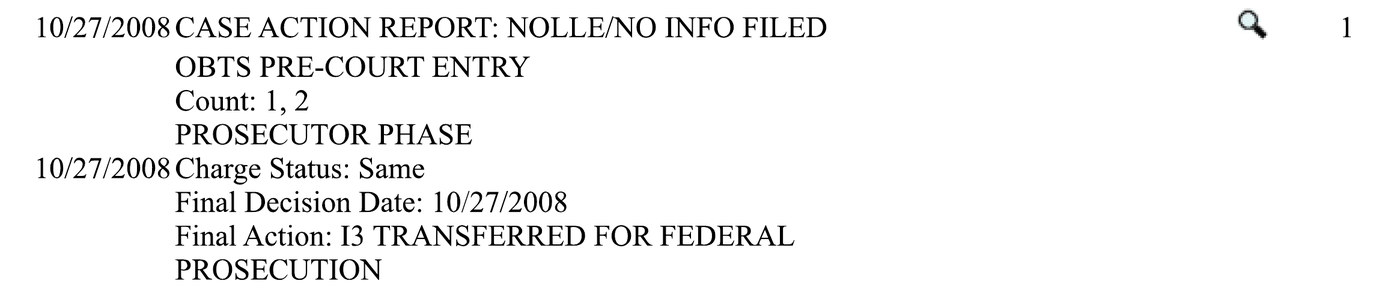
- 2008-10-27Case 003341: "CASE ACTION REPORT: NOLLE/NO INFO FILED"; OBTS final action "I3 TRANSFERRED FOR FEDERAL PROSECUTION" on both counts; both bonds set to "Released." (Alachua County Clerk docket, Case 01-2008-CF-003341)
- 2008-10-27Case 003956: count 1, "SEX OFFENSE: VIDEO VOYEURISM SUBSQ OFF," disposition "CASE DISQUALIFIED FOR PROSECUTOR STANDARDS"; counts 2-3 (computer offenses), "NO INFO VICTIM DOES NOT WISH TO PROSECUTE." A second uncertified printout shows count 1 differently; a certified copy is needed. (Alachua County Clerk uncertified printouts, Case 01-2008-CF-003956)
- 2008-10-28"CERTIFICATE OF CANCELLATION" (1 p.) in case 003341. What was cancelled is not stated. (Alachua County Clerk docket, Case 01-2008-CF-003341, p. 1)
- After 2008-10-27Federal prosecution follows the documented transfer of case 003341. Federal filings have not been supplied.
- UndatedFeigin says he pleaded guilty in federal court to a computer-related offense, believing probation was likely and describing that outcome as having been "promised." No federal record has been supplied.
- 2009-05-20A docket entry in case 003341 is shown only as "XXXX." The content is not visible on the supplied printout. (Alachua County Clerk docket, Case 01-2008-CF-003341, p. 1)
- c. nine months after arrestFeigin says his relationship with his then-girlfriend ended shortly before he went to prison, and that he ended it. (Feigin's account; approximate)
- UndatedFeigin says he was sentenced to 30 months in federal prison and later entered federal custody. No judgment has been supplied.
- Undated (after release)Feigin says his rights were later restored after the felony conviction and that he received "some form of apology." No record of either has been supplied.
6Publicly documented evidence
The evidence reviewed to date consists of uncertified Alachua County Clerk of Court web printouts and one court-filed letter. No federal record, police report, forensic examination, plea agreement, judgment, news article or copy of the e-book has been supplied. A second letter addressed to the federal court has been provided but has not been authenticated and is not relied upon.
- State dockets (uncertified printouts). The Clerk records document the July 31, 2008, arrest and filing in case 01 2008 CF 003341 A; two $10,000 surety bonds with a status date of August 1, 2008; written not-guilty pleas; a notice of appearance by private counsel and a 10-page notice of discovery on October 16, 2008; and the October 27, 2008, dispositions described in the court-proceedings section. A second case, 01 2008 CF 003956 A, appears under a different Gainesville Police Department agency number and includes the video-voyeurism count. (Alachua County Clerk uncertified printouts, Cases 01-2008-CF-003341 and 01-2008-CF-003956)
- Inconsistency between printouts of case 003956. One uncertified printout of case 003956 describes count 1 as "SEX OFFENSE: VIDEO VOYEURISM SUBSQ OFF" with the disposition "CASE DISQUALIFIED FOR PROSECUTOR STANDARDS." A second uncertified printout of the same case shows count 1 with no charge description and the disposition "NO INFO VICTIM DOES NOT WISH TO PROSECUTE." This case study follows the more complete printout and flags the inconsistency. A certified copy of the docket will resolve it.
- Filed letter of August 28, 2008. Feigin's then-girlfriend filed a letter in case 01 2008 CF 003341 A asking that her desktop computer be returned and that a no-contact order be lifted. She wrote that the computer was given to the investigating detective "under panicked emotions," that Feigin "had always had complete permission to use my computer for whatever reason," and that "The order was put on by me under the influence and manipulation of [the detective]." (Letter filed Aug. 28, 2008, Alachua County Clerk, Case 01-2008-CF-003341, p. 1) Her characterization of the detective is her opinion as stated in the letter and has not been independently established. A duplicate copy of the same filed letter was also supplied and adds no new content.
- What is not in the supplied record. The printouts do not mention an e-book, eBay, spyware, captured images, a computer-repair business, or a list of eight potential victims. They do not contain forensic results. They are not complete case files.
7Court proceedings
Circuit Court, Eighth Judicial Circuit, Alachua County, Florida, Judge Ferrero, division F2.
Case 01 2008 CF 003341 A (Gainesville Police Department agency number 02-08-014375; booking number ASO08JBN009256):
- Filed July 31, 2008, the same day as the recorded arrest date. (Alachua County Clerk case summary and docket, Case 01-2008-CF-003341)
- Two third-degree felony computer-offense counts, as described on the docket.
- August 1, 2008: arrest form, first-appearance order ("REVIEW *LINDAS* SYSTEM FOR ALL CONDITIONS"; the conditions themselves were not supplied), provisional appointment of the Public Defender, affidavit of indigent status, and two $10,000 surety bonds with that status date. (Alachua County Clerk docket, Case 01-2008-CF-003341, pp. 2–3)
- August 4, 2008: surety bonds docketed; written plea of not guilty.
- August 28, 2008, 8:52 a.m.: letter from Feigin's then-girlfriend filed, addressed to Judge Rosier. (Alachua County Clerk docket, Case 01-2008-CF-003341, p. 2; letter, p. 1)
- October 16, 2008: notice of appearance by private counsel, replacing the Public Defender; a second written plea of not guilty; and a 10-page Notice of Discovery.
- October 20, 2008: letter from the Clerk's office to defense counsel.
- October 27, 2008: "CASE ACTION REPORT: NOLLE/NO INFO FILED"; OBTS final action "I3 TRANSFERRED FOR FEDERAL PROSECUTION" on both counts; both bonds set to "Released."
- October 28, 2008: "CERTIFICATE OF CANCELLATION" (what was cancelled is not stated). May 20, 2009: a docket entry shown only as "XXXX."
Case 01 2008 CF 003956 A (Gainesville Police Department agency number 02-08-016802), also before Judge Ferrero. Filing and arrest dates do not appear on the supplied printouts. Three counts were disposed on October 27, 2008: the video-voyeurism count as "CASE DISQUALIFIED FOR PROSECUTOR STANDARDS," and the two computer-offense counts as "NO INFO VICTIM DOES NOT WISH TO PROSECUTE." (Alachua County Clerk docket, Case 01-2008-CF-003956, p. 2) A second uncertified printout of this case describes count 1 differently, as noted in the evidence section.
Federal court. The state docket records a transfer for federal prosecution on October 27, 2008. No federal case number, charging document, plea agreement, or judgment has been supplied. Feigin says he later pleaded guilty to a computer-related offense and was sentenced to 30 months.
8Judicial findings & verdicts
No supplied state record shows a trial, a verdict, a conviction, or any judicial finding of fact about the underlying events. The October 27, 2008, entries are charging and disposition decisions, not findings that the allegations were proved or disproved.
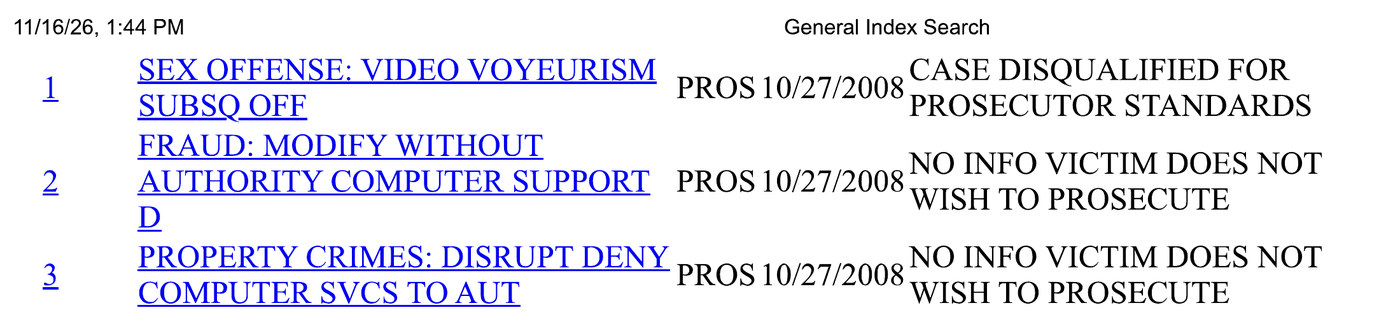
- In case 01 2008 CF 003956 A, the video-voyeurism count was marked "CASE DISQUALIFIED FOR PROSECUTOR STANDARDS," and the two computer-offense counts were marked "NO INFO VICTIM DOES NOT WISH TO PROSECUTE." (Alachua County Clerk docket, Case 01-2008-CF-003956, p. 2) Those entries record that the State declined to proceed. They are not an acquittal, an exoneration, or a finding that an allegation was false. In Florida practice, "No Info" generally means no formal information was filed; "prosecutor standards" generally refers to charging criteria such as sufficiency of evidence. The docket does not say which standard applied.
- In case 01 2008 CF 003341 A, both computer-offense counts were marked "TRANSFERRED FOR FEDERAL PROSECUTION," with a case-action report of "NOLLE/NO INFO FILED." (Alachua County Clerk docket, Case 01-2008-CF-003341) The State's computer charges were not dropped on their merits; they were closed because the matter was handed to federal prosecutors.
Feigin says he later pleaded guilty in federal court to a computer-related offense and was sentenced to 30 months in federal prison. A guilty plea is an admission under oath to the elements of the offense charged. Until the federal judgment, plea agreement and factual basis are reviewed, that outcome remains his account, and this case study cannot identify the federal statute or the facts he admitted.
9Subsequent developments
After the October 27, 2008, transfer, Feigin says a federal prosecution went forward, that he pleaded guilty to a computer-related offense, and that he was sentenced to 30 months in federal prison. He says he had expected probation and describes that expectation as having been "promised." No federal record has been supplied to confirm the charge, the plea terms, the sentence or the dates of custody.
Feigin says his relationship with his then-girlfriend continued for about nine months after the arrest and ended shortly before he went to prison, and that he ended it. He also says that, after his release, his civil rights were later restored and that he received "some form of apology." Restoration of civil rights, as a general matter, does not erase or overturn a conviction. A pardon, a vacatur and an exoneration are each different and stronger, and none is indicated in the supplied record. Until a restoration certificate or order and the apology are supplied, those statements are his account only.
Feigin says a newspaper article and later national coverage, including CNN, followed the arrest, and that the coverage has affected his reputation for years. No article, transcript or clip has been supplied, so this case study makes no claim about what any outlet reported. He also says a woman who appeared in that coverage presented herself as a victim, which he disputes, and that she later faced public harassment. She is not named here, and those statements have not been independently documented from the materials in hand.
This profile will be updated as additional documents, including federal court records, become available.
Analysis & context
Evidence review ongoing. This case study reflects the records reviewed to date and will be updated as additional documents become available. Federal court records have not yet been reviewed.
An Investigative Case Study Published by The False Allegation Project
By The False Allegation Project Research Desk
An investigative case study of the 2008 prosecution of Craig Matthew Feigin
Disclosure: Craig Feigin provided his account of the events described in this case study and supplied supporting documentation, including legal records and correspondence. The False Allegation Project Research Desk reviewed the materials provided and distinguishes between documented facts, personal recollections, allegations made by others, and questions that remain unresolved.
Additional disclosure: Craig Feigin owns and operates The False Allegation Project. Readers should weigh this case study with that relationship in mind. That is why each significant statement below is labeled with its source.
Scope: This case study relies only on materials Feigin supplied, with one noted exception. The supplied materials are uncertified web printouts of Alachua County, Florida, Clerk of Court records; one court-filed 2008 letter (plus a duplicate copy); and Feigin’s own first-person draft. A second letter addressed to the federal court has also been provided, but it has not been authenticated and is not relied upon. At Feigin’s request, the Research Desk also reviewed one Orlando Sentinel article dated February 10, 2015, used only in the subsection “What Became of the Case’s Prosecutor.” No other outside research was done. No federal court record, police report, forensic report, plea agreement, or judgment has yet been supplied. Statements about the federal case, the sentence, and other media coverage therefore rest on Feigin’s account until those records are reviewed.
1. The E-book That Became a Criminal Investigation
In 2008, Craig Feigin was a college student running a small eBay business that sold inexpensive digital products: e-books, PDFs and instructional manuals. By his description, the listings relisted automatically after each sale, and the catalog ran to thousands of titles. He says it was his main source of income.
One product carried the title “Webcam Spy Hacker.” Feigin says the title was chosen to be sensational because provocative listings drew clicks. He says he also adapted his listing’s sales copy from the sales pages of other software products.
According to Feigin, no software ever existed. The product, priced at $3.99, was a written guide to assembling a cheap motion-detection security camera for one’s own home or office from existing tools:
- LogMeIn, for remote access to one’s own computer;
- free camera software that captured images when it detected motion;
- an FTP server to synchronize the captured images;
- optional low-cost web hosting to store them.
He says he built the setup in his own room, where it produced thousands of motion-triggered images of himself. He also says the idea grew out of using a similar arrangement after he caught someone taking items from his room. His position is that the guide taught nothing about entering other people’s computers, secretly installing anything, or watching anyone.
The e-book itself, its eBay listing, and its sales copy have not yet been supplied. This case study therefore cannot say what the guide contained, or how the listing described it to buyers. The title alone settles neither question. A sensational title does not prove sinister content, and Feigin’s description of harmless content is not yet backed by the text. The product’s significance in the prosecution is also undocumented. No supplied court record mentions an e-book, eBay, or “spyware.”
Fact check
Was spyware found on anyone’s computer?
No evidence in the record
Feigin says no spyware was found on anyone’s computer. No supplied forensic report, police report, or charging document alleges that spyware was found, and no supplied court record mentions spyware at all.
Source: absence from the supplied state-court printouts and the August 28, 2008, letter. No forensic report has been supplied.
The record vs. the narrative: The product
Question What the supplied record shows What the media reported No supplied record yet. What the charging documents alleged No charging document (information, complaint, or arrest affidavit) has been supplied. The docket’s charge descriptions mention computer offenses, not an e-book or software: “FRAUD: MODIFY WITHOUT AUTHORITY COMPUTER SUPPORT D” (s. 815.04(1)) and “PROPERTY CRIMES: DISRUPT DENY COMPUTER SVCS TO AUT” (s. 815.06(1)(B)). (Alachua County Clerk uncertified printout, Case 01-2008-CF-003341, p. 1) What witnesses said in supplied statements The then-girlfriend wrote in 2008: “This particular project was always talked about by Craig and I did not think anything of it.” (Letter filed Aug. 28, 2008, Alachua County Clerk, Case 01-2008-CF-003341, p. 1) What the court decided No supplied record shows any court finding about the e-book. What remains unverified The e-book’s contents; whether “spyware” ever existed; how investigators described the product.
2. The Detective at the Door
Feigin says he learned of the investigation when a detective came to his home. At first he assumed it concerned a roommate. He says he invited the detective in and rode voluntarily in the police car to the station. There, he says, the detective said the inquiry concerned eBay listings and computer activity.
By Feigin’s account, he immediately said he was behind the listings, explained what the e-book contained, and offered the names of women he knew so the detective could speak with them. They returned to his home and he handed over his computer, believing an examination would clear things up. He recalls being arrested at home immediately afterward. This sequence is his recollection. The supplied records do not show what led to the arrest or what probable cause was cited.
The court record corroborates parts of this chronology:
- July 31, 2008: the docket lists the arrest date, and the case was filed the same day. (Alachua County Clerk docket and case summary, Case 01-2008-CF-003341)
- August 1, 2008: an arrest form, a first-appearance order, a provisional order appointing the Public Defender, and an affidavit of indigent status were entered. (Alachua County Clerk docket, Case 01-2008-CF-003341, p. 3)
- Bond: two $10,000 surety bonds list a bond status date of August 1, 2008. (Alachua County Clerk docket, Case 01-2008-CF-003341, pp. 2–3)
These entries fit Feigin’s memory of being released on bond the day after his arrest. They do not by themselves record the release time.
The supplied records identify the arresting agency as the Gainesville Police Department, under agency number 02-08-014375. (Alachua County Clerk case summary, Case 01-2008-CF-003341, p. 2) The 2008 letter refers to the investigating detective of that department. (Letter filed Aug. 28, 2008, Alachua County Clerk, Case 01-2008-CF-003341, p. 1) The first-appearance order says to “REVIEW *LINDAS* SYSTEM FOR ALL CONDITIONS,” but the conditions themselves were not supplied. (Alachua County Clerk docket, Case 01-2008-CF-003341, p. 3)
A point the record raises. Feigin remembers handing over his computer. The then-girlfriend’s filed letter says the detective had her desktop computer, which she gave him “under panicked emotions.” (Letter filed Aug. 28, 2008, Alachua County Clerk, Case 01-2008-CF-003341, p. 1) Both may be true, since more than one computer may have been taken. The property and evidence receipts, which have not been supplied, would show which devices were seized, from whom, and on what authority.
3. Eight Potential Victims — How Were They Identified?
Feigin believes the names he gave the detective were later used to build a list of about eight potential victims. He says they were simply women he knew, not “female customers who asked for computer repairs.” He did not run a computer repair business, he says, and never installed the software on anyone else’s computer. He believes investigators contacted some of these women and may have examined some of their computers. He maintains that nothing from those contacts was ever used as evidence and that no spyware was found on anyone’s computer.
None of the supplied documents mentions eight potential victims, a computer repair business, or the results of any examination of anyone’s computer.
Fact check
Was Feigin a computer repairman targeting women?
No evidence in the record
Feigin says coverage described him as a computer repairman who targeted attractive women, and that he did not run a computer repair business. No supplied court record describes him that way or identifies any complainant as a repair customer.
Source: absence from the supplied Alachua County Clerk printouts. No police report, charging affidavit, or news article describing that portrayal has been supplied, other than Feigin’s account of the coverage.
What the record does show. There were two separate state cases, with two separate Gainesville Police Department agency numbers:
- 01 2008 CF 003341 A: GPD 02-08-014375.
- 01 2008 CF 003956 A: GPD 02-08-016802.
(Alachua County Clerk uncertified printouts, Cases 01-2008-CF-003341 and 01-2008-CF-003956)
Separate agency numbers ordinarily indicate separate police reports. Whether they involved different complainants is not shown. Both cases list the same two computer-offense descriptions. (Alachua County Clerk uncertified printouts, Cases 01-2008-CF-003341 and 01-2008-CF-003956) The “victim does not wish to prosecute” dispositions in case 003956 suggest at least one complainant in that case declined to proceed, but the record does not identify that person. (Alachua County Clerk docket, Case 01-2008-CF-003956, p. 2)
The claim that investigators described the women as computer-repair customers, and that this was later “disproven,” cannot be assessed until the police reports, the arrest affidavit, and any media reports using that phrase are supplied. The docket’s “victim does not wish to prosecute” language records a complainant’s wishes. It is not a finding that an allegation was disproven.
The record vs. the narrative: The alleged victims
Question What the supplied record shows What the media reported No supplied record yet. Feigin says coverage described a “computer repairman” targeting attractive women. What the charging documents alleged No supplied record yet. The dockets show two cases with separate police agency numbers. Neither names a victim or describes how complainants were identified. (Alachua County Clerk uncertified printouts, Cases 01-2008-CF-003341 and 01-2008-CF-003956) What witnesses said in supplied statements One witness, the then-girlfriend, wrote that Feigin “had always had complete permission to use my computer for whatever reason.” (Letter filed Aug. 28, 2008, Alachua County Clerk, Case 01-2008-CF-003341, p. 1) No statements from any other woman have been supplied. What the court decided Case 003956 counts were disposed on Oct. 27, 2008, as “NO INFO VICTIM DOES NOT WISH TO PROSECUTE” and, for the voyeurism count, “CASE DISQUALIFIED FOR PROSECUTOR STANDARDS.” (Alachua County Clerk docket, Case 01-2008-CF-003956, p. 2) No court made a finding of fact. What remains unverified The number of potential victims; whether any were described as repair customers; whether any computer other than the then-girlfriend’s was examined, and with what result.
4. The Woman Identified as a Victim
Feigin says the person most directly connected to the investigation was his then-girlfriend. He says she already knew about the e-book and the camera setup, including that the idea grew out of catching someone taking items from his room. He believes she was frightened and confused when police approached her, and felt pressure to cooperate.
The most important supplied document on this point is her own letter, filed with the Alachua County Clerk at 8:52 a.m. on August 28, 2008, in case 08CF3341 and addressed to the judge. (Letter filed Aug. 28, 2008, Alachua County Clerk, Case 01-2008-CF-003341, p. 1; docket entry in the same case) It is the only supplied statement from any witness that bears a court filing stamp.
The full letter, with identifiers redacted, is reproduced near the top of this case study, under “The Letter She Filed With the Court.”
In it, she described the events of “a few weeks ago” as “both confusing and misconstrued.” She wrote that the detective “has possession of my desktop computer which was given to him under panicked emotions.” She said she had given it to him “because he is a detective for the Gainesville Police Department and I felt I had to cooperate with an authority figure.” She went on: “When the detective came to me about this case, he painted an image of Craig that both scared me and made me feel that I had to cooperate for my safety.” (Letter filed Aug. 28, 2008, Alachua County Clerk, Case 01-2008-CF-003341, p. 1)
On the question at the heart of the computer charges, which concerned unauthorized access, she was direct. “I realized that Craig had always had complete permission to use my computer for whatever reason,” she wrote. “If my computer is being used against Craig with the claim that he is not supposed to do something on it, then it would be untrue.” (Letter filed Aug. 28, 2008, Alachua County Clerk, Case 01-2008-CF-003341, p. 1)
She also wrote: “This particular project was always talked about by Craig and I did not think anything of it.” The letter does not say which project she meant. Read alongside Feigin’s account, it may refer to the camera setup, but that link is an inference, not something the letter states.
She asked the court to lift the no-contact order and return her computer: “The order was put on by me under the influence and manipulation of [the detective].” (Letter filed Aug. 28, 2008, Alachua County Clerk, Case 01-2008-CF-003341, p. 1) Her characterization of the detective’s conduct is her opinion as stated in the letter. The Research Desk has not established it as fact, and no response from the detective or the department has been supplied.
The letter supports Feigin’s account in several ways:
- She did not regard herself as harmed: “I do not feel as though Craig is any type of threat to me.”
- She said Feigin had permission to use her computer.
- She said he had discussed “this particular project” with her.
(Letter filed Aug. 28, 2008, Alachua County Clerk, Case 01-2008-CF-003341, p. 1)
The letter also shows something Feigin’s account does not mention: by her own statement, she had initially sought or agreed to a no-contact order (“put on by me”).
A second letter addressed to the federal court has been provided but has not been authenticated and is not relied upon.
Feigin says the two stayed together for about nine months after his arrest, ending shortly before he went to prison, and that he ended the relationship.
5. From State Allegations to Federal Prosecution
The supplied record documents the state side of the case in useful detail.
Case 01 2008 CF 003341 A (Gainesville Police Department agency number 02-08-014375), Judge Ferrero, division F2:
- Filed: July 31, 2008. (Alachua County Clerk case summary, Case 01-2008-CF-003341, pp. 1–2)
- Counts: two third-degree felonies:
- Count 1: “FRAUD: MODIFY WITHOUT AUTHORITY COMPUTER SUPPORT D,” s. 815.04(1).
- Count 2: “PROPERTY CRIMES: DISRUPT DENY COMPUTER SVCS TO AUT,” s. 815.06(1)(B).
- Pleas: written pleas of not guilty were filed on August 4 and October 16, 2008. (Alachua County Clerk docket, Case 01-2008-CF-003341, p. 2)
- Defense: private counsel filed a notice of appearance on October 16, 2008, replacing the Public Defender. (Alachua County Clerk docket, Case 01-2008-CF-003341, p. 2)
- Discovery: a 10-page Notice of Discovery was filed the same day. (Alachua County Clerk docket, Case 01-2008-CF-003341, p. 2)
- Disposition: on October 27, 2008, the docket records “CASE ACTION REPORT: NOLLE/NO INFO FILED.” An OBTS entry for both counts records “Final Action: I3 TRANSFERRED FOR FEDERAL PROSECUTION.” Each count’s disposition reads “TRANSFERRED FOR FEDERAL PROSECUTION.” (Alachua County Clerk docket, Case 01-2008-CF-003341)
- Bonds: both bonds were given the status “Released” the same day. (Alachua County Clerk docket, Case 01-2008-CF-003341, p. 2)
- Afterwards: a “CERTIFICATE OF CANCELLATION” followed on October 28, 2008, and an entry dated May 20, 2009, appears only as “XXXX.” (Alachua County Clerk docket, Case 01-2008-CF-003341, p. 1)
Case 01 2008 CF 003956 A (agency number 02-08-016802), also before Judge Ferrero:
- Counts: three counts, all disposed on October 27, 2008. (Alachua County Clerk dockets, Cases 01-2008-CF-003341 and 01-2008-CF-003956)
- Count 1: “SEX OFFENSE: VIDEO VOYEURISM SUBSQ OFF.” Disposition: “CASE DISQUALIFIED FOR PROSECUTOR STANDARDS.” (Alachua County Clerk docket, Case 01-2008-CF-003956, p. 2)
- Counts 2 and 3: the same two computer-offense descriptions as case 003341. Disposition: “NO INFO VICTIM DOES NOT WISH TO PROSECUTE.” (Alachua County Clerk docket, Case 01-2008-CF-003956, p. 2)
- Filing and arrest dates: neither appears in the supplied printouts.
A note on the record itself: A second uncertified printout of case 003956 shows count 1 with no charge description and the disposition “NO INFO VICTIM DOES NOT WISH TO PROSECUTE.” This differs from the more complete printout of that case, which this case study follows while flagging the inconsistency. A certified copy of the 003956 docket will resolve it. (Alachua County Clerk uncertified printouts of Case 01-2008-CF-003956)
What these dispositions mean, and what they do not. None of these entries is an acquittal. None is a finding that Feigin did not commit the conduct alleged, and none is an exoneration.
- Case 003956: the State declined to proceed. The docket gives the reasons as a complainant’s wishes (“VICTIM DOES NOT WISH TO PROSECUTE”) and, for the voyeurism count, “PROSECUTOR STANDARDS.” Terminology note for counsel to confirm: in Florida practice, “No Info” generally means no formal information was filed. “Prosecutor standards” generally refers to the prosecutor’s charging criteria, such as sufficiency of evidence. The docket does not explain which standard applied.
- Case 003341: the State’s computer charges were not dropped on their merits. They were closed because the matter was transferred for federal prosecution.
That distinction matters to the central question of this study. The record does support Feigin’s position that the only sex-offense charge on the supplied state dockets was not prosecuted. (Alachua County Clerk docket, Case 01-2008-CF-003956, p. 2) It also shows that the computer-offense case was not abandoned. It was handed to federal prosecutors. (Alachua County Clerk docket, Case 01-2008-CF-003341)
Feigin says the federal case concerned a computer-related offense, not voyeurism or any sexual allegation. That fits the state record, since the case marked for federal transfer contained only computer counts. But no federal charging document, plea agreement or judgment has been supplied, so the federal charge cannot yet be identified.
The record vs. the narrative: The charges
Question What the supplied record shows What the media reported No supplied record yet. What the charging documents alleged State docket charge descriptions: computer modification without authority and disruption or denial of computer services (both cases); “SEX OFFENSE: VIDEO VOYEURISM SUBSQ OFF” (case 003956 only). (Alachua County Clerk dockets, Cases 01-2008-CF-003341 and 01-2008-CF-003956) No federal charging document has been supplied. What witnesses said in supplied statements “If my computer is being used against Craig with the claim that he is not supposed to do something on it, then it would be untrue.” (Letter filed Aug. 28, 2008, Alachua County Clerk, Case 01-2008-CF-003341, p. 1) What the court decided Voyeurism count: “CASE DISQUALIFIED FOR PROSECUTOR STANDARDS.” Case 003956 computer counts: “NO INFO VICTIM DOES NOT WISH TO PROSECUTE.” Case 003341 computer counts: “TRANSFERRED FOR FEDERAL PROSECUTION.” (Alachua County Clerk dockets, Cases 01-2008-CF-003956 and 01-2008-CF-003341) Federal outcome: Feigin reports a guilty plea and 30-month sentence. What remains unverified The federal statute of conviction; whether any sexual or image-related allegation appeared in federal filings; the factual basis Feigin admitted.
6. The Plea Agreement and the Unexpected Sentence
Craig Feigin says he pleaded guilty in federal court to a computer-related offense and was sentenced to 30 months in federal prison. No federal record has been supplied. This case study reports the plea and conviction plainly, as Feigin describes them, because they are central facts of his account. A guilty plea is an admission under oath to the elements of the offense charged, and nothing in this study disputes that a conviction was entered. Until the judgment is reviewed, however, the plea, the charge and the sentence remain his account.
Fact check
Was Feigin convicted of a federal offense?
Yes, by guilty plea
Feigin says he pleaded guilty in federal court to a computer-related offense and was sentenced to 30 months in federal prison. A guilty plea is an admission to the offense charged. The federal record itself has not yet been reviewed, so the precise statute, the terms of the plea, and the judgment are reported here as his account.
Source: Feigin’s account. No federal plea agreement, judgment, or docket has been supplied.
Feigin describes how he came to plead:
- Fear of trial. He feared a much longer sentence if he went to trial. He recalls a figure of about five years.
- His teenage history. His attorney warned him that his teenage history could be used against him. Feigin says he was a “hacker” at 14 and that the FBI contacted him as a teenager about alleged involvement in a hacker group. No charges followed, and he says he declined to become a confidential informant.
- Expectation of probation. He says he pleaded guilty believing probation was likely, and describes it as having been “promised.” He was surprised when the judge imposed 30 months.
None of these points can yet be checked. Whether probation was a term of a written plea agreement, a non-binding recommendation, or defense counsel’s prediction is a crucial difference. (General legal note for counsel to confirm: federal plea agreements commonly state that the sentencing judge is not bound by sentencing recommendations.) Only the plea agreement, the change-of-plea transcript and the sentencing transcript will show what was represented, and by whom. Likewise, whether his juvenile-era history played any part in charging or sentencing would appear, if anywhere, in the presentence report and the sentencing record.
Feigin was 20 at the time, according to his account. Neither supplied court record shows his date of birth.
7. What the Court Documents Actually Show
Two pages from the uncertified Alachua County Clerk printouts show how the state cases were closed. Third-party names do not appear in these cropped regions.
Fact check
Was the voyeurism charge prosecuted?
No
The only voyeurism count in the supplied state record, in case 01 2008 CF 003956 A, was closed as “CASE DISQUALIFIED FOR PROSECUTOR STANDARDS.” No supplied state record shows that count being filed as an information, taken to trial, or resulting in a conviction.
Source: Alachua County Clerk docket, Case 01-2008-CF-003956, p. 2 (documented, E-4).
Fact check
Did the alleged victim support prosecution?
No
The same docket marks the computer counts in that case “NO INFO VICTIM DOES NOT WISH TO PROSECUTE.” That records a complainant’s wishes. It is not a finding that an allegation was disproven, and the printout does not identify the person.
Source: Alachua County Clerk docket, Case 01-2008-CF-003956, p. 2 (documented, E-4).
Fact check
Was there a trial or finding of guilt on voyeurism?
No
No supplied state record shows a trial, a conviction, or any judicial finding of fact on the voyeurism count, which was not prosecuted.
Source: Alachua County Clerk docket, Case 01-2008-CF-003956, p. 2 (documented, E-4); absence of any trial or verdict entry in the supplied printouts.
Fact check
Were state computer charges dropped?
Mixed / misleading
The computer counts in case 01 2008 CF 003341 A were not abandoned on their merits. They were marked “TRANSFERRED FOR FEDERAL PROSECUTION.” A separate case, 01 2008 CF 003956 A, did close its computer counts with “NO INFO VICTIM DOES NOT WISH TO PROSECUTE.” Saying that “the state computer charges were dropped” is therefore misleading if it is taken to mean the whole computer case ended.
Source: Alachua County Clerk docket, Case 01-2008-CF-003341 (documented, E-3); Case 01-2008-CF-003956, p. 2 (documented, E-4).
What the supplied records establish:
- The arrest. Feigin was arrested on July 31, 2008, by the Gainesville Police Department and appeared before a judge the next day. (Alachua County Clerk docket, Case 01-2008-CF-003341, pp. 2–3)
- Two state cases. Florida opened two felony cases. Both included two computer-offense counts. One also carried a video voyeurism count. (Alachua County Clerk dockets, Cases 01-2008-CF-003341 and 01-2008-CF-003956)
- Not-guilty pleas. He pleaded not guilty in writing in the state case. (Alachua County Clerk docket, Case 01-2008-CF-003341, p. 2)
- The then-girlfriend’s letter. On August 28, 2008, his then-girlfriend filed a letter with the state court. She said he had permission to use her computer, asked for its return, and asked that the no-contact order be lifted. (Letter filed Aug. 28, 2008, Alachua County Clerk, Case 01-2008-CF-003341)
- The October 27, 2008, dispositions.
- The voyeurism count: “CASE DISQUALIFIED FOR PROSECUTOR STANDARDS.”
- The computer counts in case 003956: “VICTIM DOES NOT WISH TO PROSECUTE.”
- The computer counts in case 003341: “TRANSFERRED FOR FEDERAL PROSECUTION.”
- No state trial or findings. No supplied state record shows a trial, a verdict, a conviction, or a judicial finding of fact. The printouts are uncertified and are not complete case files.
What the supplied records do not establish (yet): what the e-book contained; whether any spyware or images of other people were found; who the complainants were; what the federal charge was; what facts Feigin admitted; what any news outlet reported; and what restoration of rights or apology, if any, later occurred.
These records cut in both directions. They support Feigin’s account that the sex-offense allegation did not result in a charge being prosecuted in state court. They also support his account that his then-girlfriend, at the time, disputed that he lacked permission to use her computer. At the same time, the record contradicts any suggestion that “all charges were dropped.” The computer charges in case 003341 led to a federal prosecution and, by Feigin’s account, a felony conviction.
8. The Public Narrative That Never Went Away
Feigin says a newspaper article followed his arrest and that national coverage, including CNN, followed. He says the coverage portrayed him as a computer repairman who targeted attractive women, installed spyware on their computers, and may have obtained intimate images. He believes the reporting relied heavily on the investigating detective, and that it turned a cheap home-security e-book into a story about voyeurism. He says the effect on his reputation has lasted for years.
Fact check
Were intimate images discovered?
No evidence in the record
Feigin says coverage suggested he may have obtained intimate images. No supplied forensic report, charging document, docket entry, or filed letter records that intimate images were found.
Source: absence from the supplied state-court printouts and the August 28, 2008, letter. No forensic report or news clipping has been supplied.
No newspaper article, broadcast transcript, or video clip has yet been supplied. This section therefore cannot yet compare any outlet’s wording with the court record, and it makes no claim about what any journalist reported or why.
The public face of an allegation
Feigin says a woman who appeared in CNN coverage publicly presented herself as a victim. He says he and she had a personal disagreement before the case became public. He disputes that she had firsthand knowledge of the alleged computer activity or was a victim of it. He believes her public role lent credibility to a story her firsthand knowledge did not support. He also recalls that she later faced public harassment and criticism, including claims that her statements were inconsistent.
None of this has been independently documented from the materials supplied. The Research Desk has not identified her from the court records in hand, and she is not named here. Feigin’s recollection that she was later harassed is noted only as his account. If true, it would be a sobering part of the story: public allegation narratives can harm accusers and accused alike. Any discussion of it must avoid adding to that harm.
Before this subsection can be expanded, the record needs:
- the CNN segment or transcript in which she appears;
- any police report or docket listing her as a complainant;
- documentation of the prior disagreement Feigin describes, if any exists;
- a right-of-reply invitation to her, if she is to be described in any identifiable way.
9. The Questions the Record Leaves Behind
The supplied documents answer some questions and sharpen others.
- What did police allege, and on what basis? The arrest affidavit and police reports for both agency numbers (02-08-014375 and 02-08-016802) would show what conduct was alleged, who the complainants were, and what the detective attributed to the e-book.
- What did the forensic examinations find? No supplied record shows whether any spyware, remote-access software or captured images were found on Feigin’s computer, on his then-girlfriend’s computer, or on anyone else’s. This is the single most important factual gap.
- Why was the voyeurism count “disqualified for prosecutor standards”? The State Attorney’s case-action report or no-information memo may say.
- Who was the complainant in each state case? Was the then-girlfriend’s computer the subject of case 003341, the case transferred to federal court? Her letter was filed in that case and carried its police agency number. (Letter filed Aug. 28, 2008, Alachua County Clerk, Case 01-2008-CF-003341) If so, the federal prosecution may have centered on access to a computer whose owner told the state court he had “complete permission” to use it. That would be a significant finding, but it is not yet established.
- What exactly did Feigin plead guilty to, and what facts did he admit? The federal plea agreement and factual basis would answer this.
- What was said about probation, and by whom? The plea agreement, the plea colloquy and the sentencing transcript would answer this.
- What did the coverage say, and was it ever updated?
- What restoration, apology or relief did Feigin later receive? Feigin recalls having his rights restored after the felony conviction and receiving “some form of apology.”
- Restoration of civil rights (general legal note for counsel to confirm) restores rights such as voting. It does not erase or overturn the conviction.
- An apology, depending on who gave it, may carry moral weight but has no legal effect.
- A pardon, a vacatur and an exoneration are each different and stronger, and none is indicated in the supplied record.
The record vs. the narrative: Summary
Question What the supplied record shows What the media reported No supplied record yet. What the charging documents alleged Docket charge descriptions only: computer offenses (both cases) and video voyeurism (case 003956). No charging instrument supplied. (Alachua County Clerk dockets, Cases 01-2008-CF-003341 and 01-2008-CF-003956) What witnesses said in supplied statements Then-girlfriend (filed 2008): Feigin had “complete permission” to use her computer; she gave her computer to the detective “under panicked emotions”; she did not want the no-contact order. (Letter filed Aug. 28, 2008, Alachua County Clerk, Case 01-2008-CF-003341) What the court decided State: no trial or conviction. Voyeurism count not prosecuted (“prosecutor standards”); computer counts in 003956 not filed (“victim does not wish to prosecute”); computer counts in 003341 transferred for federal prosecution. (Alachua County Clerk dockets, Cases 01-2008-CF-003341 and 01-2008-CF-003956) Federal: guilty plea and 30-month sentence, according to Feigin. What remains unverified Whether any images or spyware existed; what the e-book contained; the federal charge and plea terms; media wording; the identity and role of the woman Feigin says appeared in CNN coverage; restoration of rights; the apology.
Where Is He Now
According to Feigin, in the years since the federal case he has had no further legal trouble. He says he went on to build a successful business, and that he is married and has children. Those statements are Feigin’s account. They have not been independently documented in the materials reviewed for this case study, and this section does not address his finances.


What Became of the Case’s Prosecutor
The Orlando Sentinel reported on February 10, 2015, that Alachua County deputies had arrested the ex-wife of Frank Williams, an assistant U.S. attorney, on suspicion of attempted murder after, deputies said, she shot and wounded him in the Gainesville area. According to the Sentinel, Williams told investigators he was at the house to pick up his daughter and deliver paperwork related to a property the two shared, and that she reached for a gun and aimed at his chest. The Sentinel, citing the Gainesville Sun, reported that he jumped out of the way but was hit in the arm, and that bones were broken. The Sentinel reported that the ex-wife was being held in the county jail on a $200,000 bond.
Source: Orlando Sentinel, “Ex-wife shot federal prosecutor in Gainesville area, deputies say,” published February 10, 2015 (updated June 16, 2018). https://www.orlandosentinel.com/2015/02/10/ex-wife-shot-federal-prosecutor-in-gainesville-area-deputies-say/
Feigin’s opinion
Feigin believes his prosecution was driven by press attention.
Corrections and right of reply: The Research Desk welcomes comment from the Gainesville Police Department, the State Attorney’s Office for the Eighth Judicial Circuit, the U.S. Attorney’s Office for the relevant district, and any outlet whose coverage is later quoted. Private individuals will not be identified. This case study will be updated as additional documents become available.
10Sources & references
- Court record Alachua County Clerk of Court, Case/Name Information printout for cases 01 2008 CF 003341 A and 01 2008 CF 003956 A (uncertified web printout; a certified copy has not been supplied)
- Court record Alachua County Clerk of Court, Case Summary for 01 2008 CF 003341 A (uncertified web printout)
- Court record Alachua County Clerk of Court, Docket List for 01 2008 CF 003341 A (uncertified web printout)
- Court record Alachua County Clerk of Court, Party Charges for 01 2008 CF 003956 A (uncertified web printout)
- Court record Letter filed August 28, 2008, in Case 01 2008 CF 003341 A, addressed to the state-court judge (supplied copy of a court-filed letter; a duplicate copy of the same letter was also supplied)
- Other Undated letter addressed to the U.S. District Court (supplied; not authenticated and not relied upon in this case study)
- Other Preliminary first-person narrative and interview account provided by Craig Feigin